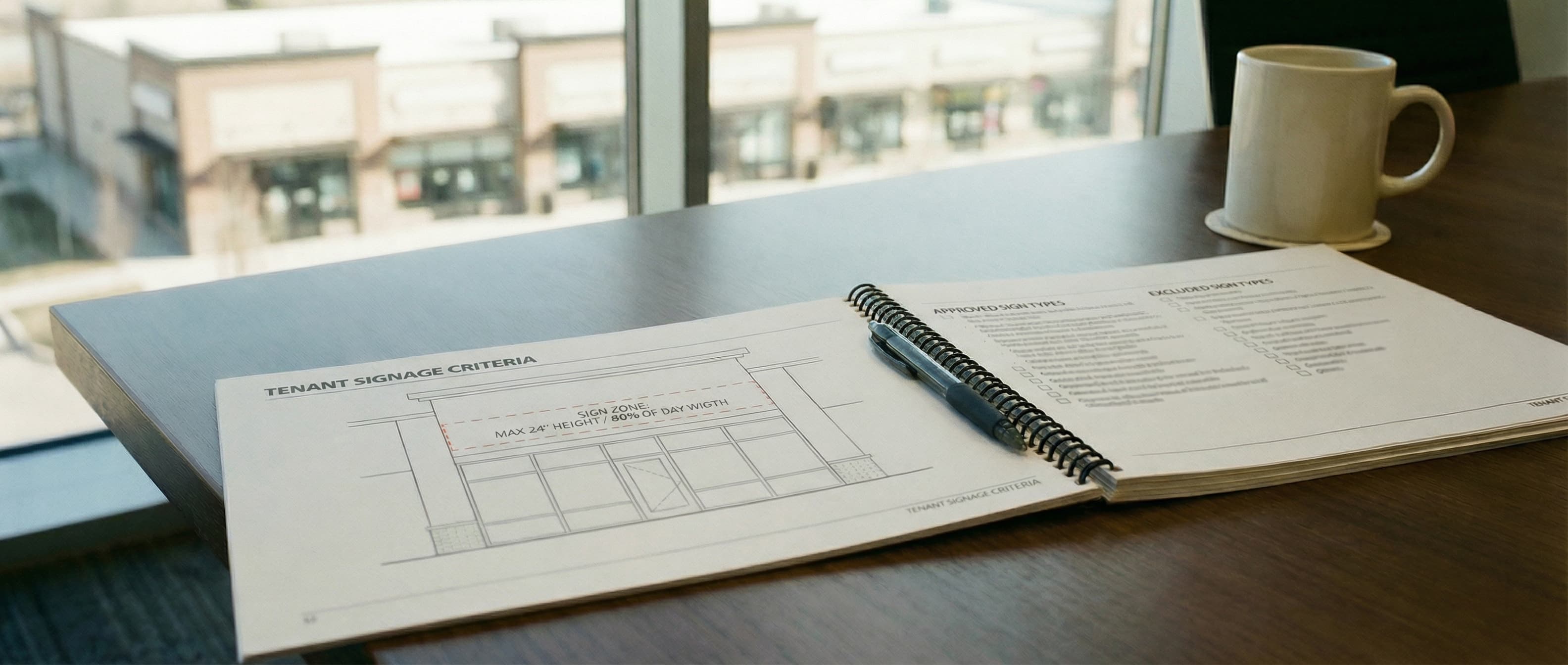
Master sign programs
Fight the sign battle once
Without a program, a multi-tenant property refights the same battle on every lease: each tenant designs, submits, and argues with the city from scratch, and ten years in the building wears the result, a fascia where nothing agrees with anything. The city hates reviewing it, the landlord hates looking at it, and every new tenant inherits the chaos.
A master sign program ends that. The rules get designed once, approved once, and enforced by paperwork instead of arguments. We write the document, draw its exhibits, and carry it through approval as part of our signage documentation work.
Allowed sign types
Which sign families each tenant class may use, drawn as exhibits, with the prohibited list stated plainly.
Size formulas
Sign area scaled to frontage or tenancy by formula, so the answer is arithmetic instead of negotiation.
Placement zones
Sign bands and zones drawn on the elevations, so every sign lands where the architecture expects it.
Submittal process
What a tenant submits, who approves it, and in what order, so the program enforces itself.






We write and draw master sign programs and carry them through municipal approval.

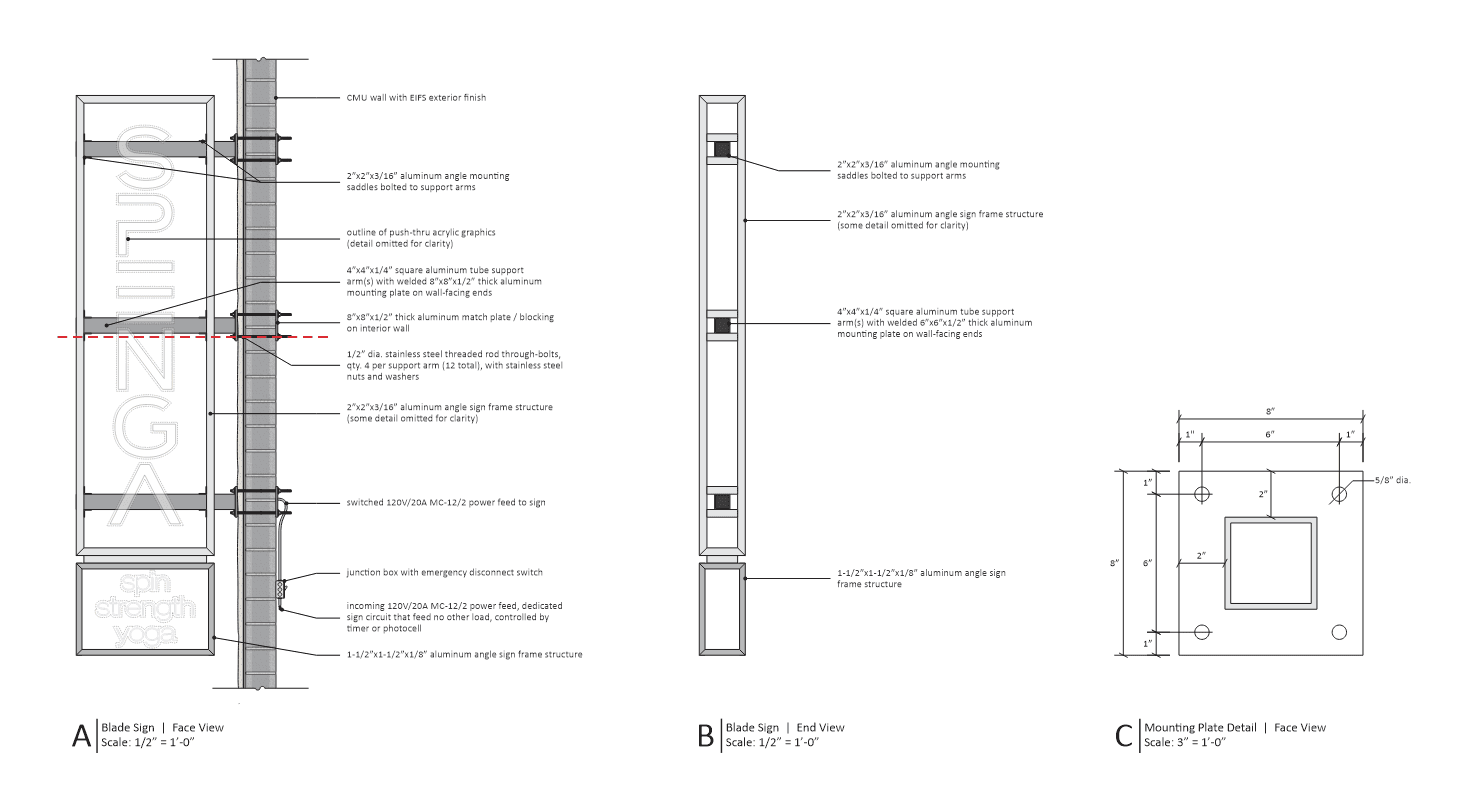



Who we work with


Sign companies
White-label design and drawings for busy shops. We draw, you fabricate, and your client never knows we were involved.


Architects & designers
Signage and wayfinding documented to sit inside your set, on your schedule, drawn to the standard your drawings hold.


Facilities & property teams
Wayfinding and sign standards for campuses, portfolios, and multi-building sites that have outgrown the signs they started with.


Brands & retailers
Sign programs that hold the brand across every location and bend to each local code, without ever losing the look you built.
Master sign programs, answered
Didn't find your question? Ask us directly — straight answers, no runaround.
- Is a master sign program required?
- Many jurisdictions require one for multi-tenant and planned developments, under names like comprehensive sign plan, planned sign program, or uniform sign plan. Even where it's optional, most cities will trade you flexibility for one: a program can often negotiate sign rights the base code wouldn't give a tenant walking in alone.
- What's the difference between a master sign program and tenant criteria?
- The master program is the deal with the city, and tenant criteria are the rules the landlord hands each tenant. They're two audiences for the same standards, and we usually write them as one coordinated document so the criteria never promise a tenant something the program didn't win from the city.
- How long does approval take?
- Longer than a single sign permit and worth it. Depending on the jurisdiction it runs from a staff-level review measured in weeks to a planning-commission item measured in months. Every tenant sign after approval then permits against the program, which is where all that time comes back.
- Can you revise an existing program?
- Yes, and it's common work. Programs written in 2005 don't anticipate today's tenants, LED technology, or the rebrand your anchor just went through. We amend the document, take the amendment through the city, and the property gets a rulebook that matches what actually needs to be built.
Read more


Good signage
starts with a conversation.
Every project is different. Let’s talk about yours.